
The most common question in a tummy tuck consultation is not “can you do it?” — it is “which procedure is actually right for me?” The answer depends on what is causing the problem. Loose skin, excess fat, and separated muscles are three different issues that require different approaches. Understanding which one you have is the first step.
Explore Tummy Tuck Surgery at Panache →
Tummy Tuck vs Liposuction — Understanding the Difference
These two procedures are often confused, but they address different problems:
Liposuction removes fat deposits beneath the skin. It requires skin that has adequate elasticity to contract after fat is removed. If skin is loose before liposuction, it will be looser after.
Tummy Tuck (Abdominoplasty) removes excess skin, tightens the underlying abdominal muscles, and removes fat. It is the correct procedure when skin laxity is the primary concern — not fat volume alone.
Choosing incorrectly — having liposuction when you needed a tummy tuck — results in worsened skin laxity and a poor outcome that is difficult to correct.
Before & After — Tummy Tuck Results at Panache
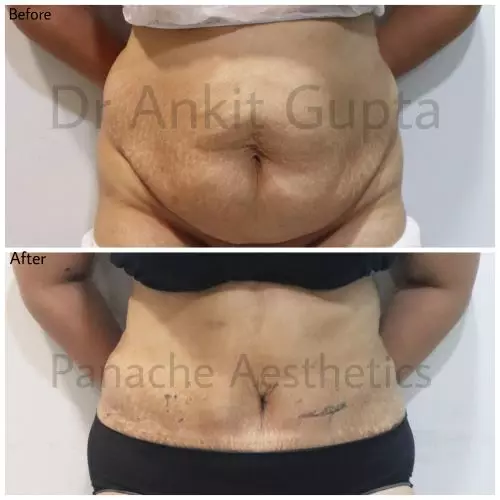



Results show a flat, toned abdomen with the scar placed low within the bikini line. Final result visible at 3–6 months.
View Full Tummy Tuck Gallery →
Who Is the Ideal Candidate?
1. You Have Loose or Sagging Abdominal Skin
The most common cause is pregnancy — the skin stretches significantly and does not fully retract even after weight normalises. Major weight loss (whether through diet, bariatric surgery, or exercise) also leaves excess skin that no amount of core training can remove.
The key test: if you can pinch and lift the lower abdominal skin into a fold, there is excess skin that will benefit from excision.
2. You Have Diastasis Recti (Separated Abdominal Muscles)
Diastasis recti is a separation of the rectus abdominis muscles along the midline, most commonly occurring during pregnancy. It creates a characteristic bulge or “pooch” in the lower abdomen that persists regardless of body weight or exercise.
Tummy tuck surgery includes repair of this separation — the muscles are sutured back together, restoring a flatter abdominal profile and improving core stability. This component alone is a significant reason many post-pregnancy women choose abdominoplasty.
3. You Are at a Stable Weight
A tummy tuck is a body-contouring surgery, not a weight-loss procedure. Candidates should be within their target weight range — or within 5–10 kg of it — and have maintained that weight for at least 3–6 months.
Significant weight gain after tummy tuck will stretch the repaired skin and muscles again, compromising results. Significant weight loss will leave residual excess skin.
4. You Have Completed Your Family
Future pregnancies stretch the abdominal muscles and skin. While a tummy tuck does not prevent pregnancy, it will reverse the surgical result. For this reason, surgery is generally recommended after you are confident your family is complete.
This is not an absolute rule — patients in their early 30s who have had their children and are otherwise ideal candidates should not wait indefinitely. A thorough discussion at consultation determines the right timing.
5. You Are a Non-Smoker in Good General Health
Smoking significantly impairs wound healing and increases the risk of skin necrosis (tissue death) in tummy tuck surgery — particularly along the incision line and the area around the navel. Smoking cessation for a minimum of 4–6 weeks before and after surgery is mandatory.
General health: candidates should have no uncontrolled diabetes, bleeding disorders, or active cardiac conditions. A pre-operative health assessment is performed before clearance.
6. You Have Realistic Expectations
A tummy tuck produces a flatter, tighter abdomen with a low horizontal scar. It is not a scar-free procedure, and the scar — while placed within the bikini line — is permanent. It fades significantly over 12–18 months but will always be visible on close inspection.
It also does not address flanks, back, or other body areas — these may benefit from concurrent liposuction, which is commonly combined with abdominoplasty at Panache.
Types of Tummy Tuck Procedures
Mini Tummy Tuck
For patients with excess skin limited to the lower abdomen (below the navel). Smaller incision, navel position unchanged, faster recovery. Suitable for patients with minimal diastasis and good upper abdominal tone.
Full Tummy Tuck
Addresses the entire abdomen — upper and lower. The navel is repositioned. Full muscle repair included. The standard procedure for post-pregnancy abdominal changes.
Extended Tummy Tuck
Extends to the flanks and hip area. Appropriate for patients with skin laxity wrapping around the sides — common after major weight loss.
Tummy Tuck + Liposuction
Very commonly combined. Liposuction addresses residual fat in the flanks, back, and hips that the tummy tuck does not address. Combined procedures maximise result in a single recovery period.
Recovery Timeline
| Timeline | What to Expect |
|---|---|
| Day 1–3 | Drainage tubes in place (if used). Rest with head and knees slightly elevated. |
| Day 4–7 | Drains typically removed. Walking encouraged. |
| Week 2 | Swelling present but improving. Most patients manage desk work. |
| Week 4–6 | Compression garment worn. Light activity resumed. |
| Month 3 | Most swelling resolved. Scar softening begins. |
| Month 6 | Final contour visible. Scar fading well underway. |
Who Is NOT the Right Candidate
- Patients planning future pregnancies — wait until family is complete
- Active smokers who cannot stop for the required period
- Patients with BMI over 35 — weight loss first is recommended
- Those expecting a scar-free result
- Patients with significant upper abdominal skin laxity seeking only a mini tummy tuck
Frequently Asked Questions
Is a tummy tuck covered by insurance? No. It is a cosmetic surgical procedure. However, if there is a functional component (such as significant diastasis recti causing back pain), documentation may be provided for insurance purposes — though coverage is rare.
Can I have liposuction instead of a tummy tuck? If your primary concern is fat with good skin tone — yes. If you have skin laxity, liposuction alone will worsen it. The correct procedure is identified at consultation after physical examination.
Will I need a drainage tube? Most full tummy tucks at Panache use closed-suction drains for 3–5 days post-operatively. These are removed at the first follow-up and cause minimal discomfort.
How long does the result last? Permanently, provided weight is maintained and no future pregnancies occur. The removed skin does not return. The muscle repair is permanent.
Book a Tummy Tuck Consultation at Panache →
Also read:


